
Night Vision for Sailors: Dim White light or Red light?
Learning Objectives
1) Describe how human vision changes at night and why darkness adaptation matters.
2) Identify which types of vision are most important for night sailing and lookout duties.
3) Explain how bright light can impair night vision and how to minimize its impact.
4) Choose lighting strategies on board that balance safety, comfort, and preservation of night vision.
You may remember the redlight submarine scenes in the movie “The Hunt for Red October”. It has generally been believed that red light is the best method of protecting what we call night vision. But is this true? With LED lights one can get any color simply and inexpensively – would green be better? Why not white light? The answer to these questions is that the really important issue is to use dim light. However, there are specific benefits to red light. To understand why, we first need to learn about how the eye works.
Light enters the eye, first passes through the iris (constricts and dilates based on light intensity) , then to the lens, which focusses the light to a spot at the back of the eye called the fovea which is part of a sheet called the retina. Sharp images of the external world are first formed on this tiny part of the retina. The rest of the retina also contains cells but they are responsible for our peripheral field of view. When something moves to your side and you “see it” it is detected by this peripheral vision.
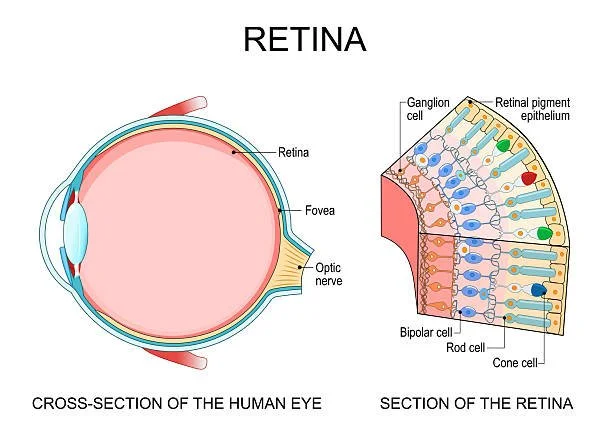
The retina of the eye is comprised of cells that are broadly called photoreceptors (photo – light, receptor – detector). Photoreceptors are divided into two categories of cells: rods and cones. As the names imply, they have distinct shapes. Rods are not color sensitive but see shades of gray and are highly light sensitive. In contrast, cones detect specific colors. There are three types of cones. Ones that detect red, green and a third that detect blue light.
Cones are located at the fovea and are why we can discern the color of objects that we focus on. Rods surround our cones and detect light from the peripheral field of view.
Birds have a fourth cone that is UV sensitive. UV light (black light) is a highly effective tool for detecting mouse feces, urine, and hair helping identify runways, entry points, and high-activity areas. In nature, this UV assists some birds in locating prey
Therefore, when looking at a tell-tale on the sail, we see that object using our cones at the fovea. But if we pass the float of a lobster pot as you are looking forward, it’s our rods that detect the lobster pot first since they detect the peripheral field. But then as you turn your gaze to the float the light is now directed to the fovea and we can clearly see its form and the colors of its markings.
What is night vision and why are we so careful about protecting it? Within each photoreceptor is a protein, called a photopigment, that absorbs light and sets off the cascade of events that allows our brain to “see”. In the dark or in dim light there is more of this photoprotein within each cell so that the photoreceptor is much more sensitive to dim light. But as the light intensity increases the amount of photopigment decreases – one could say it is photobleached. There is more light so we don’t need to be supersensitive. So with night vision our photoreceptors have more light sensing photopigment to make them supersensitive.
But you are probably asking what does this have to do with night vision and red headlamps? We need to go back to the 1940s for the answer.
In World War II the navy realized there was a problem with submariners looking at instruments and charts, then having to lookout for distant ships and coastlines. After looking at the instruments they lost their night vision and found it difficult to see distant objects while on lookout. It took 10-20 minutes to recover their night vision. They tested different intensities and colors of lights and found that dim red light impacted night vision least. This led to the conversion to red lighting in the submarine.
What is the difference between red, green or blue light? Later, in physiological studies it was found that rods, the highly sensitive photoreceptors responsible for peripheral vision, are weakly sensitive to red light. Therefore dim red light doesn’t photobleach the rods. Bingo! Hence the conversion of boats to “red light at night, mariners delight”. However, it should be noted that rods still do have some sensitivity and a bright red light will still lead to photobleaching and loss of night vision.
A problem with using red lights is we are not able to detect different colors. A red line on a white background when illuminated with red light will not be detectable. The background and the line both appear to be red. Red light illumination can lead to visual distortions of reality. Many sailboats have their halyards, reefing lines and sheets color coded. With red light illumination you cannot discriminate the colors. Observing the different colors requires all cones to be used which requires white light. Also, red markings on charts are not visible when illuminated with red light.
Therefore, it is safer and more effective to use dim white light to illuminate within the boat to allow visual processing of running rigging and other cues in the boat. One still wants to maintain the night vision of the rods, if possible, because using your peripheral vision is a very effective way to look for other vessels or for land masses. If you choose white light it should be dim to preserve night vision.
I generally prefer to use dim white light when illumination is needed. I have found that when sailing solo white light is much more effective in allowing me to reef quickly since I can quickly get a color confirmation of my reefing lines and halyards and shorten sail much faster than with a red light. BUT, I emphasize DIM white light. Dim light won’t photobleach your rods.
Also read this interesting article which discusses the need to abandon red light and to move to dim white light.
Do an experiment to test your headlamp and night vision: An interesting experiment would be test the impact of your headlight on your night vision. While at anchor let your eyes dark adapt for 30 minutes. Then identify dim distant objects, note them down by compass location. Turn on your white (or red) headlamp for 5 minutes and work in the cockpit. Now with the headlamp off look for those distant objects. How long does it take for them to reappear? Do you prefer dim white or red light? Does dim white light affect your night vision? Is your red light dim enough not to cause a loss of night vision?
When you are in very high traffic areas and close to shore red might be preferred because you want to ensure your peripheral vision is not impaired. But do the test at anchor that I describe. This will let you sail with confidence with dim white or red light. We spend so much time testing all aspects of our boat before a race. Why not spend 30 minutes testing your headlamp and use the data you collect to inform you whether the light, regardless of color, is dim enough to retain your night vision.
Headlamp Design: There are many designs of headlamps available, but they should be researched carefully. Some have both red and white lights, but only one switch. One click turns the white light on, the second the redlight and the third shuts it down. Your first click turned on bright white light and you can kiss your night vision goodbye. If this is a problem and you only want the red light a simple solution is to stick a piece of black electrical tape over the source of the white beam.
Don’t forget the lighting is also important while off watch. How often does someone come onto watch from a brightly light beneath decks area? Their first 20 minutes on watch are now allowing their photoreceptors to regain their sensitivity and night vision. Similarly, it’s important to turn the intensity of all light source down including computer screens used for routing, chart plotters, tablets and phones.
Many animals including dogs rabbits, foxes and cats have high sensitivity night vision. This is in part because they have a membrane behind the retina that reflects any light that passed through the retina back to the photoreceptors to give it a second chance to be detected.
Sailor Takeaway
Rods = night vision; protect them.
Cones = detail and color; use them when necessary.
Color‑coded lines require white light.
Managing brightness—not just switching to red—is the real key to maintaining night vision offshore.
Keep all cockpit and cabin lighting extremely dim at night.
Use peripheral vision to detect boats, waves, and horizon cues—rods are concentrated there.
Expect night‑vision loss after looking at bright screens; use night mode or minimum brightness.
