
Polyphasic Sleep and how to nap offshore (3 of 3 on Sleep)
Learning objectives
1) Understand when to use brief, short and long naps
2) Identify cues that inform you that you need to nap
3) Understand why alcohol should not be drunk prior to departure
4) Understand why caffeine makes you sleepier, not less.
5) Identify why you can use different sleep strategies when solo and doublehanded
Offshore sailing forces a departure from normal sleep. Most people live on a monophasic schedule. On land we go to sleep at night and wake 7-8 hours later, in an ideal world. Offshore, sailors are unable to do this and have to adopt polyphasic sleep—multiple short sleep episodes across the 24h day.
Claudio Stampii, a sleep researcher and offshore sailor, was the first to study polyphasic sleep. He noticed in his own Whitbread Ocean racing that crew would naturally take short naps. After noticing this strategy, he studied sailors napping tendencies and because EEG recordings (electrical recordings made from the scalp to measure brain activity) are impractical at sea, he used accelerometers to measure periods of activity and inactivity, which he then inferred to be periods of sleep and wakefulness. One accelerometer was attached to the boat and the other to the sailor. By measuring the difference in the signals he could identify when a sailors movement was due to boat movement and when it was due to the sailor moving in relation to the boat.
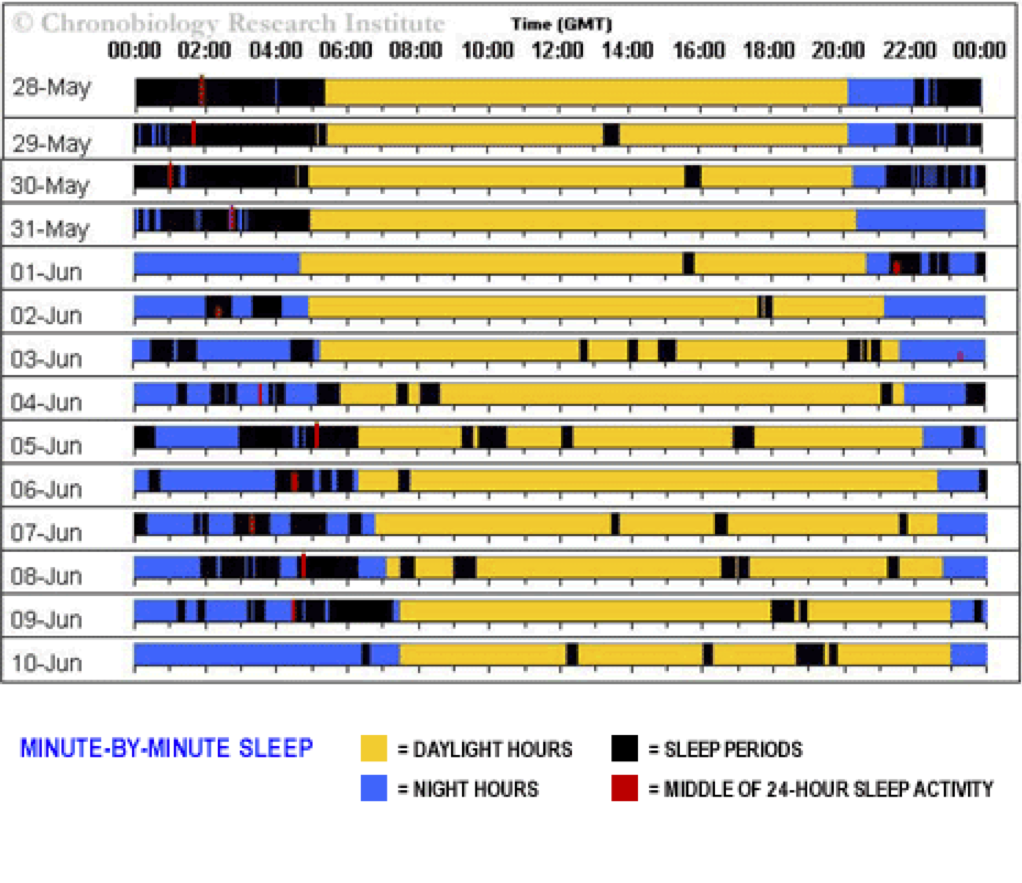
Rich Wilson's Sleep Patterns Prior to and During the Transat Race on GAII
By Dr. Claudio Stampi, MD, PhD.
Chronobiology Reseach Institute, Boston, Massachusetts—June 12, 2004
Note clustered short naps in the afternoon and longer total nap time at night.
Across numerous sailors, consistent patterns emerged. Experienced solo sailors cluster brief naps during daylight and take longer sleep periods at night.
Short naps of 20–30 minutes are effective because they reduce sleep pressure (let some air out of the ballon) without entering deep sleep. These naps allow rapid awakening for lookout checks and system monitoring. When close to shore or when traffic is dense even brief naps of 5 mins can be effective. Several brief naps add up: nap for 5 minutes, wake and have a look out. Then keep repeating this cycle.
20-30 mins is a sweat-spot for me, but slightly longer may work for you. Test it. The key is to find the balance between getting restorative sleep, and being able to wake quickly from a nap without sleep inertia. I find that 45 minutes is too long and I wake with terrible sleep inertia. The general concept of polyphasic sleep while sailing is discussed in this sailing video.
Short naps alone do not permit REM sleep which come later in a sleep cycle. Some sailors tolerate this; others develop hallucinations and impaired judgment. I fall into the latter class.
Controlled experiments show that prolonged polyphasic sleep can overwhelm alarm responsiveness. This occurs when the total accumulated sleep duration over many days is too short. Sleep pressure may eventually prevent awakening, raising concerns near the end of long races. Polyphasic sleep works—but only if managed deliberately and adjusted to individual needs. But polyphasic sleep can be extremely effective if one is able to accumulate enough total sleep time per day to prevent negative effects of limited sleep.
My rule of thumb is that an offshore race is a marathon which can be lost in the last hours. Therefore, it is necessary to start napping early and often, to minimize the sleep pressure in the balloon at the end of the race. This permits effective boat control, lookout and race strategy from the start until the finish of the race.
How I Sleep While Sailing Solo Offshore: A Practical, Brain‑Based Strategy
Offshore, theory collides with reality. Squalls arrive early, traffic is denser than expected, and systems behave unpredictably. Consequently, napping as often as is feasible allows one’s brain to be prepared to function effectively when confronted by this reality. Don’t wait until nighttime to get in your naps, an unexpected series of squalls, unexpected sea traffic, or repairs will prevent your nighttime napping. But if you have already reduced sleep pressure by consistently taking every opportunity to nap you will manage the unexpected with greater mental clarity.
I rely on three types nap:.
1) I will take very brief naps of 5 minutes when closer to shore and in high traffic areas.
2) When there is less traffic and time permits I will take twenty‑minute naps which I find to be very restorative. They reduce sleep pressure without entering deep sleep. I typically set an alarm for 25 minutes.
3) Ninety‑minute naps allow a full sleep cycle including REM sleep. I use them sparingly and only when conditions permit.
In my numerous Newport to Bermuda races, either solo or doublehanded, I like to start taking brief 5-10 minute, naps by 1600 on the first afternoon. During the first night one is still sailing on the continental shelf where there is a lot of traffic and fishing vessels, many of which do not use AIS. Therefore, every minute of sleep from my first 1600 nap is restorative and helps during the first night when naps are limited. Because of ocean traffic a sequence of brief naps (5-10 minutes) are often safer than one longer 20 minute nap. Afterall, they are cumulative and so two closely spaced 10 minute naps reduce sleep pressure as much as one 20 minute nap.
Once off of the continental shelf where there is less traffic I regulalrly take 20 minute naps and will take an occasional full sleep cycle nap (90-100 minutes) so that I can get my REM sleep and prevent hallucinations that I am sensitive to.
The first day of a race is deceptive. The overall excitement of finally being on the race course, after months of preparation, can limit sleep. But I often say to sailors, close your eyes regardless of whether you think you sleep. Rest, and your brain waves will change and be restorative and this will help reduce fatigue.
An often unrecognized problem is the danger associated with approaching land at the end of the race when exhausted. Banking sleep early and often pays dividends later as it allows you to navigate coastal features, shallow waters and to approach the correct finish line with confidence. I know of one sailor (who shall be nameless) who entered the waypoint of the finish line at the wrong location. They entered the waypoint at government buoy R2 in the wrong bay. Although they made the waypoint mistake before the race, did sleep deprivation impair their ability to recognize the problem as they were approaching land?
How do I know if I need to sleep? There are many tell tail symptoms that will tell you its time to nap. However, hopefully now you will be so vigilant about napping that you will not get to this stage in your future sailing. Some cardinal features and warning signs for sailors of sleep deprivation include:
· Delayed response time to perform functions that require thinking or acting.
· Staring at your computer screen as you download GRIB files, and forgetting steps in the routing procedure. What is the next step?
· Pausing and having to remind to yourself what you are supposed to be doing. Why did I put the winch handle in the winch? Endlessly gazing at the telltales. Why am I sitting in the salon? Why did I fill this water bottle? What did I do for the last 30 minutes? General confusion. All of these symptoms have one solution. Naps!
Pre-race behaviors: optimizing your brain for peak performance
Regardless of whether you are, solo, doublehanded or are fully crewed you should modify your pre-race behavior significantly. You need to remember that you are an offshore athlete and you need your mind and body to be ready for optimal performance. You need to be ready for decisive and thoughtful action when the unexpected happens regardless of its timing.
Should I use caffeine to stay awake? No! If you drink caffeinated drinks on land, I recommend withdrawal from caffeine well in advance of a race. This drug acts on the same molecules in the brain that mediate the consequences of sleep deprivation/pressure. This is why we use it to stay awake; on the short term caffeine masks the receptors required to mediate the sleep promoting effects of sleep deprivation. There are two reasons not to use it:
First, and largely unrecognized outside of the sleep research community and a limited number of shorthanded sailors, is the fact that chronic caffeine use increases the number of receptors in the brain that mediate the molecular signaling that drives us to sleep. Thus, the long-term consequence is that the brain is to amplify the effects of sleep deprivation and one will become drowsy more easily. Therefore, abstinence before a race and during is important.
Second, the half-life of caffeine is 4-5 hours. (Half-life of caffeine or any drug for that matter refers to the duration of time that it takes for the chemical to decrease in concentration to ½ of its peak level. This is accomplished by metabolism (chemical breakdown) or excretion (for example in urine) of the chemical.) One needs to go through two half-lives (8-10hours) to allow sufficient metabolism of caffeine to permit good sleep. Therefore, if after sunrise you were to have a tea or coffee it would take many hours for your brain to be easily able to sleep again. This is not acceptable. You need to take every opportunity to take a nap. If, after sunrise, you walk around your sailboat for an equipment check, do a routing and check sail trim one should immediately take a nap if tired. But if you had taken a caffeinated drink you might feel alert, but this is a fallacy. You are just blocking sleep promoting effects of the sleep homeostat, and the molecules responsible for mediating sleep pressure continue to build and will seek their vengeance as caffeine wears off. Caffeine will also lead to more receptors being available to mediate the effects of the sleep homeostat once caffeine has been metabolized. You will be worse off with caffeine than you are without it.
Alcohol: It is also important to abstain from alcohol. Those pre-race send-offs with rum should be a thing of the past for you. At least the alcohol shouldn’t be consumed. I used to scoff when I was told this. I thought that so long as I don’t drink the night before a race I will be fine. This is so far from the truth. Here is the scientific explanation if you would like the logic.
Sleep deprivation, caffeine and alcohol converge on the identical biological pathway that makes one sleepy. In daily life it is well known that many people use alcohol because it is somnogenic (helps you fall to sleep). It achieves this action by raising the level of a chemical in the brain called adenosine. Sleep deprivation also raises the level of this same chemical. That is how alcohol promotes sleep. Caffeine prevents the action of adenosine, the sleep promoting molecule that sleep deprivation and alcohol elevate.
What many do not realize is that alcohol causes long term changes in this molecular pathway that outlasts the presence of alcohol. Just like caffeine alcohol increases the number of receptors in the brain that mediate the molecular signaling that drives us to sleep. This is why its important to abstain from alcohol in advance of offshore races. It is not clear how long one should abstain. I would recommend abstinence for weeks at a minimum given the known time course of biological adaptations.
Sleep: The sleep homeostat provides the pressure or drive to sleep. The homeostat integrates how long we have been awake and provides a proportional drive to sleep. Therefore, on race day one must have done all that you can to make the homeostat be at ground state. This requires several days of quality sleep. This can be facilitated by abstinence from alcohol and caffeine. In addition to the rationale discussed above, although alcohol allows you to fall asleep it causes many awakenings in the second half of the night. This really impairs sleep quality and your ability to reset the sleep homeostat and bring it back to ground state for race day. More reason to abstain from alcohol.
I cannot overemphasize how important sleep is prior to a race.
Single versus Doublehanded watch schedule
As I have written these sleep blogs I have often discussed this from the perspective of the solo sailor. But the key biological functions of the brain allow us to have simple take aways for both solo and doublehanded races.
Key take away messages from understanding the brain are: short naps 10-30 minutes and full sleep cycles (90-100 minutes) are better nap durations than intermediate sleep periods. You may recall this is because one is in light NREM sleep after these durations allowing one to wake easily and be cognitively effective.
Because solo sailors have to do everything and while on the continental shelf and close to land they can only afford short (20 mins) or even brief (5 mins) naps until they can nap with a full sleep cycle in less congested waters.
With the doublehanded racers, they have the luxury of being able to rotate through a full sleep cycle for each off-watch period. When Alex and I competed in the 2024 Newport Bermuda race we used two-hour watch/off watch cycles. This permitted time for the crew member who was going off-watch to change clothing, to sleep for a full 90 minute sleep cycle, wake, get dressed and be ready for their on-watch session. We then had a 30-minute overlap where we could discuss what had happened, download GRIB files and make any routing decisions, make sure one another was hydrated and eat together as necessary. That being said, when the conditions dont permit it is important to be flexible with watch schedules. In another case, the conditions were such that we were both very tired, so we rotated 30 minute on/off watch to allow each crew member time to nap frequently. Because of the earlier conditions that did not permit rest, one crew member could not have stayed awake for a full 2 hour watch session. Therefore, we used our knowledge of sleep to adapt on the fly.
Sleep—like sail trim, sail selection, and routing—is a critical element that underpins effective sailing and race performance, whether sailing solo or doublehanded. The importance of sleep was best demonstrated by Charlie Dalin, the winner of the 2024/25 Vendee Globe. In an interview with Shirley Robertson on her podcast he discussed how he decided to test the idea of achieving 95% of his sleep potential. Rather than hang around in the cockpit and doing nothing he changed tactics and tested the idea of going beneath deck beneath to get more sleep. He tested this idea in his last solo race in advance of the Vendee Globe. He won the race by a good margin reinforcing how important sleep is to maximize performance.
Sailor Takeaway
· Polyphasic sleep is unavoidable offshore.
· Short naps (even a few minutes) help reduce sleep pressure and to promote vigilance.
· Some sailors require REM sleep. If this is you, get a full sleep cycle when conditions permit.
· Alarms are not fail‑safe under extreme fatigue.
· Cut off alcohol and caffeine weeks in advance of race day.
· Bank sleep before high‑risk phases.
· When sailing doublehanded full sleep cycles can be used even close to land
· When conditions permit, sleep intentionally and without guilt.
